
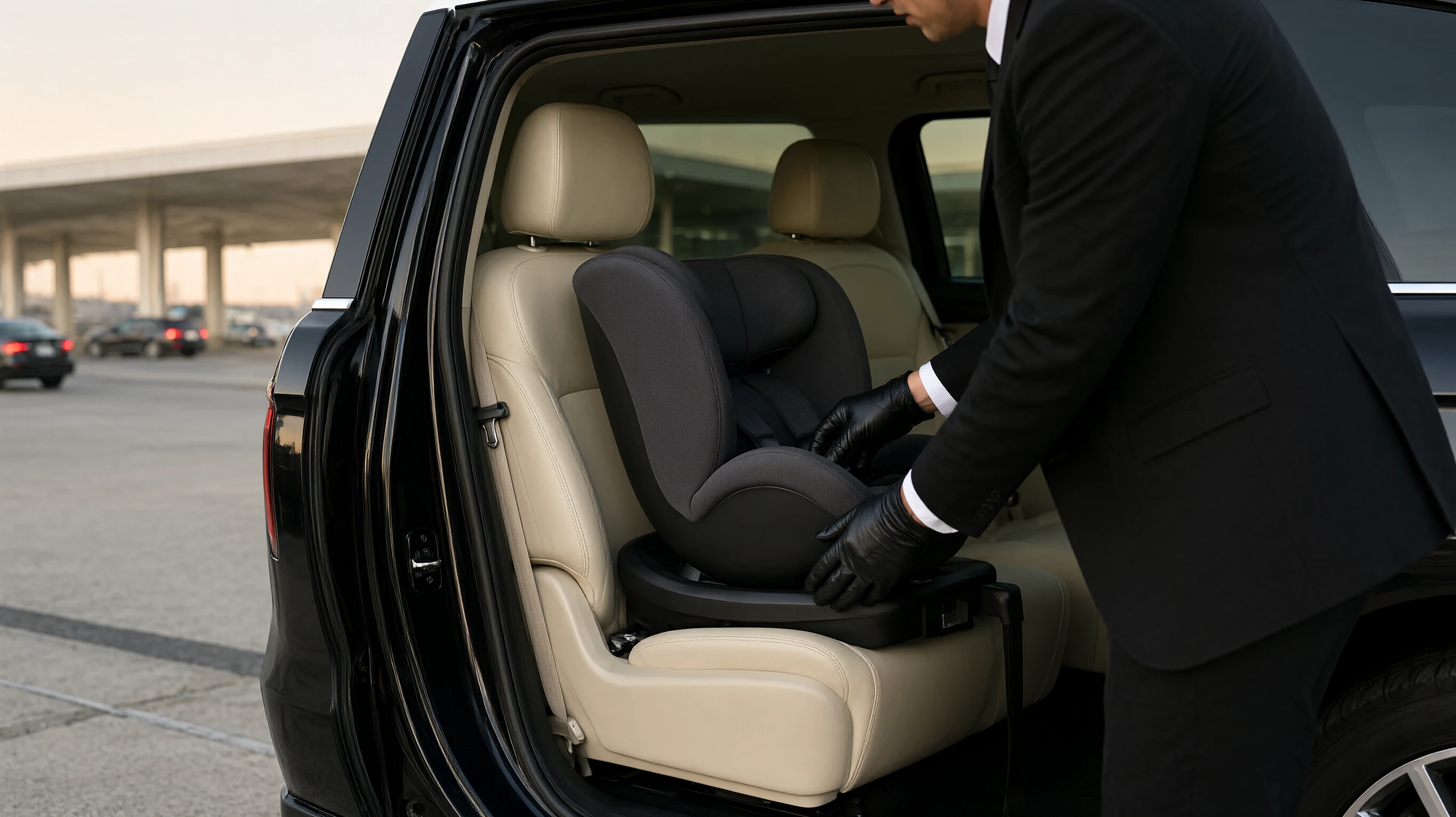
It's 7:05 at SNA. A four-year-old in a dinosaur hoodie is doing the floppy-leg thing next to a suitcase. Our chauffeur opens the second row of the Suburban we run and asks:
"Do you want to buckle her in, or should I?"
Here's the short version. Yes, a car seat is required. A limousine is a motor vehicle, and California hands chauffeured cars no pass.
We run one vehicle type, six seats. Nuna seats are free and fitted before pickup, not at the curb.
Do you need a car seat in a limo in California?
Yes. Under Vehicle Code 27360, a child under eight must ride properly secured in a rear seat in an appropriate child passenger restraint system, and the section applies to "a motor vehicle." A chauffeured limousine is a motor vehicle. The text lists no limousine exception.
| Your child | What they need | What we bring |
|---|---|---|
| Under 2 | Rear-facing seat, rear row | Nuna rear-facing, fitted before pickup |
| 2 to 7, under 4'9" | Harnessed seat or booster, rear row | Nuna seat sized to weight and height |
| Under 8 but 4'9" or taller | A seat belt is legally enough | Nothing unless you ask |
| 8 and older | Seat belt, and a fit test from 2027 | Nothing unless you ask |
Eight and up is a belt question, so we install nothing by default. Want a booster anyway? Just ask.
What California actually requires, by age
The sections that matter are 27360, 27360.5, 27363 and 27315. Full text at leginfo.legislature.ca.gov; plain English at the CHP's child safety seat page. Statutes checked against the source in October 2026.
| Age or size | What the statute requires | Section |
|---|---|---|
| Under 2 | Rear-facing restraint, unless the child weighs 40+ pounds or is 40+ inches tall | 27360(b) |
| Under 8 | Properly secured in a rear seat in an appropriate child passenger restraint system | 27360(a) |
| Under 8 and 4'9" or taller | May use a safety belt instead of a child restraint | 27363(d) |
| 8 to 15 | Safety belt; from Jan 1, 2027, only if the child passes a five-step fit test | 27360.5, now and after |
The rear seat rule trips people up. 27363(e) allows a child under eight up front only in narrow cases: no rear seat, rear seats that face sideways or backward, a restraint that won't install back there, rear seats full of kids seven and under, or medical need. And 27363(f) bans a rear-facing seat in the front seat of any vehicle with an active passenger airbag. Our second row has anchors, so none of these comes up.
The 4'9" line isn't a height requirement. It's an alternative exit from 27360 for a tall kid who hasn't turned eight. Same logic on rear-facing: 40 pounds or 40 inches is a threshold, not a milestone.
Who is legally responsible for the car seat
Read 27360(a) slowly. The list of people it points at is the point.
27360(a): "Except as provided in Section 27363, a parent, legal guardian, or driver who transports a child under eight years of age on a highway in a motor vehicle, as defined in paragraph (1) of subdivision (c) of Section 27315, shall properly secure that child in a rear seat in an appropriate child passenger restraint system meeting applicable federal motor vehicle safety standards."
Parent. Legal guardian. Driver. If you're sitting in the car with your four-year-old, you're the first name on that list.
Then comes the subdivision that gets screenshotted and misread.
27360(c): "This section does not apply to a driver if the parent or legal guardian of the child is a passenger in the motor vehicle."
Alone, that reads like a loophole. Driver's off the hook, kid rides loose, everybody's fine. It doesn't say that.
What it says is narrower. When a parent is in the car, this section doesn't apply to the driver. It doesn't say the child may ride unrestrained, and it doesn't repeal 27360(a) for the parent in row two, who is still named in it. The duty doesn't vanish. It stops pointing at the person holding the wheel.
The same rule appears again in 27360.5(b), which covers the older kids. The Legislature wrote it twice, in two sections, on purpose. That's a structure, not an oversight.
You can see why an operator would lean on it. A shrug and a 27360(c) citation tell you what kind of company you booked.
One more point, because you will read that limousines are exempt. The text doesn't support it. The section next door, 27315(d)(3) — it becomes (d)(2) on January 1, 2027 — names "the operator of a limousine for hire" explicitly, so the Legislature does write limousine rules. 27360 has none. Motor vehicle here means "a passenger vehicle, a motortruck, or a truck tractor, but does not include a motorcycle." A Suburban is a passenger vehicle. If someone argued a long stretch limo is a bus rather than a passenger vehicle, 27318 covers that too: any passenger under 16 on a belted bus has to be properly restrained. Either road ends in the same place.
What "car seat provided" should actually mean
"Car seats available on request" costs a company nothing to write and tells you nothing. It can mean a Nuna, correctly fitted, or a cracked seat from a storage unit. Our amenities page lists what we stock.
Fitted before pickup, not at the curb. A correct install takes two hands, a knee in the cushion, and a couple of minutes. At SNA there's no shade and a line of cars behind you, so we do it in the lot at 6:30.
The right seat for weight and height, not age. A 42-pound three-year-old and a 31-pound five-year-old need different seats. Age doesn't settle it.
Rear-facing until the threshold, not a birthday. 27360(b) says under two means rear-facing, "unless the child weighs 40 or more pounds or is 40 or more inches tall." Plenty of two-year-olds still fit that way in a Suburban.
Tether, headrest, belt path. A forward-facing harness needs the top tether, and the anchor hides under the seat back. A high-back booster needs the shoulder belt through the guide, crossing the collarbone and not the neck.
Rideshare, taxi, or chauffeured car: who brings the seat
Rideshare works if you bring your own seat and install it in a stranger's back seat in the rain at LAX. We compared sharing a van with a private car in more detail.
| Option | Seat supplied? | Who fits it |
|---|---|---|
| UberX, standard Lyft | No | You, in whatever car arrives |
| Uber Car Seat (a separate product in Los Angeles and a few other markets) | Yes | You confirm the fit |
| Lyft car seat mode | Yes, New York City only | You |
| Taxi | Rarely | You |
| Chauffeured Suburban | Yes, included in the quote | Us, before pickup |
Uber Car Seat is real, Los Angeles is one of the cities that has it, and Uber's own page lists a Nuna RAVA good from 5 to 65 pounds, by reservation, $10 extra. It's one seat per car, and Uber puts the install inspection on the parent. Landing at LAX at 11pm with two kids, that last part decides it.
On taxis: the statute doesn't carve them out of 27360. Note that 27315(d)(1) exempts a taxi operator on a city street with a fare aboard, covering the driver and passengers 16 and over. Carve-outs get written deliberately. 27360 doesn't have one.
What changes on January 1, 2027
AB 435, signed in October 2025, takes effect January 1, 2027 and rewrites "properly restrained" for kids who've outgrown the car seat.
After that date, a child aged 8 through 15 is only properly restrained by a belt if they pass all five steps: back against the seat, knees over the edge, shoulder belt across the chest and not the neck, lap belt low against the thighs, and staying that way for the trip. Fail one and the child needs a booster. The 4'9" exit survives: AB 435 repeals 27363 and re-enacts it the same day, height rule intact. What changes is the belt. The same bill defines "properly restrained by a safety belt" as the five-step test, so from 2027 a tall seven-year-old can use a belt only if it actually fits.
This catches the families who treat the eighth birthday as the finish line. If your nine-year-old is the smallest in her class, book the booster.
Three questions to ask before you book
1. Is the seat already installed when the car arrives, or does someone fit it at the curb? Curb installs in the dark are how seats end up loose.
2. Which seat, exactly, for my child's weight and height? A model name tells you more than "we have car seats."
3. What if my flight lands two hours late? Make sure the seat stays with the car.
Frequently Asked Questions
Yes. Vehicle Code 27360 requires a child under eight to be properly secured in a rear seat in an appropriate child passenger restraint system, and it applies to "a motor vehicle." A chauffeured limousine qualifies.
Not lawfully, if they're under eight and under 4'9". The provision people cite, 27360(c), only says the section doesn't apply to the driver when a parent or guardian is a passenger. It doesn't allow an unrestrained child, and the parent is still named in 27360(a).
The requirement follows the child, not the company. Standard UberX and Lyft cars don't supply seats, and the statute doesn't carve taxis out either. Uber Car Seat exists in some markets, including Los Angeles, but the parent still checks the install.
Yes, and no. Nuna seats are included with every booking and fitted before pickup. Tell us their weight and height when you book so we bring the right one.
Maybe not. Under 27363(d), a child under eight who is 4'9" or taller may use a safety belt instead of a child restraint. That's an option, not a recommendation, so we bring a seat if you'd rather they used one.
Absolutely. Some parents prefer it. Our chauffeur will wait, then check the belt path and tether before we move.
Call (714) 936-5055 or request a quote with your child's age, weight, and height, and we'll confirm the seat before we confirm the car. We handle Disneyland transfers and airport runs with the seat already in the car, and if you're still picking an airport, start with choosing between SNA, LAX and Long Beach.